
(419) 862-3511 | Worship every Sunday @ 10:00am!
(419) 862-3511 | Worship every Sunday @ 10:00am!

Learn more about our church and our team!

We are a come-as-you-are church for believers and nonbelievers alike looking for connection. Learn more about our mission and vision. All are welcome here.
“To live the love and grace of God through redeeming faith in Jesus the Christ by seeking justice, loving kindness, and walking humbly with God.”
To love God, love people, and serve people.
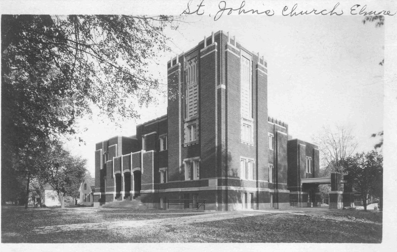
Our congregation was organized in 1860 with the name of The Apostolic St. John’s Church with 38 members.
By the early 1900s, the congregation and Sunday School had outgrown the capacity of the old building, which was located on Piety Hill in Elmore, Ohio, and it was decided that a new church would be needed. The Brotherhood, almost 40 strong, began a building fund with only $25. The new location was chosen and purchased for $2,600. The Brotherhood men and their friends raised the amount and officially presented it to the congregation on April 17, 1919.
On July 6, 1919, a building committee was appointed: Reverend Soell, Jacob Villhauer, Edward Carsten, George WEis, Edward Beck, Adam Stange, and Henry Trautman. A sub-committee was soon added, including John Weis, Edward Kuhlman, John Sampson, John Lohr, Henry Brandes, Henry Giesler, H.E. Burman, Fred Tank, Henry Kruse, Frank Weis, and F. Heineman. These surnames still exist in our current congregation!
By February 1, 1920, the committee reported $17,930 was subscribed, which was not thought to be sufficient. A goal of $25,000 was set, and just three weeks later, that goal was met.
Architects from Toledo, Ohio and a contractor from Fremont, Ohio were hired. Building plans were received in late August, and on Labor Day, farmers brought their teams of horses and a large crew of volunteers began to excavate by hand! The basement was completed by December 19, 1920.
The first brick was laid on March 22, 1921. On May 8, 1921, the cornerstone was laid. The church name at that time had changed in 1870 to St. John’s Evangelical Church.
Prior to the laying of the cornerstone, the one from the old church was removed in order to get the contents of the box and remove anything that might be placed in the new box. The old box, however, was not tight enough and all of the papers were so badly decayed that practically nothing but ashes and dust remained. The cornerstone of the new building was the gift of Velda, Wilson, and Willard Weis, the three children of Mr. And Mrs. George Weis.
Sources vary, but somewhere between 1,800 and 2,000 people from the vicinity attended the laying of the cornerstone.
After this celebration, much construction work was still needed to be done before the new church was complete. This kept everyone busy for the next seven months and several church groups added the finishing touches:
In seven months, the construction was complete and the furnishings were all installed. The beautiful new church was ready to open its doors and welcome all!
On December 18, 1921, a farewell sermon was given in the old church. The congregation marched to the new church. This procession was meant to be led by the Genoa Brotherhood Band, but it was such a cold day that the valves froze on the trumpets!
The bell, which was moved from the old church, greeted the group as they gathered at the front steps of the new church.
At 9:30 that morning, Mr. William Ehlers, supervisor of construction, handed over the keys to the pastor with these words: “By the Grace of God, we have completed this House. Therefore, I present to you, the minister of this congregation, the keys to this building in order that it may be dedicated to the service of the Triune God.”
An all day Dedication Festival was held. There was a morning service followed by a dinner in the basement. The Genoa Brotherhood Band have a short concert from the spacious stage. An afternoon services followed including a German sermon. After that, a supper was served from 5:00 PM until all were fed. An evening service which included a solo of “God’s Temple” was sung by Miss Thelma Burman – the grandmother of Lynn Great – our current Music Director!
The celebration did not stop with Sunday. Monday night, there was a Men’s Night service. After the services, all men, women, and children retired to the basement for refreshments serviced by the men. Tuesday was Ladies and Family night, after which all were invited to the social room in the basement for refreshments.
At the time of the church’s completion, the sanctuary had the largest seating capacity of any structure in Elmore. The approximate cost of construction was $67,000.
A Short Course in the History of the United Church of Christ tells our story beginning with our origins in the small community who followed Jesus 20 centuries ago and continuing to the present. Learn about the Reformation—a protest movement against the abuse of authority by church leaders; the rediscovery by Luther and Calvin of the Bible’s teaching that salvation is not earned, but is a gift; the epic journey of the Pilgrims from England to the shores of North America; the waves of emigration by German and Hungarian Protestants seeking spiritual and political freedom; the beginning of the first Christian anti-slavery movement in history; the 20th-century movement to reunite the divided branches of Christ’s church, and, as a result of that movement, the union of several traditions of Protestant Christianity into the United Church of Christ in 1957.
We invite you to use the Short Course for your personal study or as a resource for confirmation and new-member classes in your congregation. On every page, you’ll find links to related resources on this website, links to other resources on the Internet, and ideas about books for further study. Learn more at UCC’s website.
